Showing posts with label 5G. Show all posts

What is 5G?


Information is usually transmitted in various forms – over wire, radio, optical or other electromagnetic systems. Over a period of time, transmitting information has changed drastically. The current technology used for information transmission is 5G – Fifth Generation. This is the upgrade of currently existing 4G technology.


Fifth Generation (5G) in mobile communications – Basic things you need to know
Image source: Google

History of 5G:


The next generation in cellular technology is 5G, which was started at the end of 2018. On 3rd April 2019, 5G mobile services were introduced in Chicago and Minneapolis. This was the first time in the world that a 5G enabled smartphone was connected to a 5G network.


Verizon is the leading company that developed, established and accelerated 5G innovation in the initial stages. In 2015, Verizon created 5G Technology Forum (5GTF), which helped to accelerate the release of the Third Generation Partnership Project (3GPP) 5G New Radio (NR) standard in December 2017. Later, Verizon introduced a number of 5G phones, including Samsung Galaxy S10 5G, Galaxy Note 10+ 5G, LG V50 among others.


Technical aspects of 5G:


5G initially used high frequency spectrum known as millimeter wave spectrum. In 5G there exists labels like in Verizon 5G UW (Ultra-Wide) where signals are using millimeter wave, and in AT&T (American Telephone and Telegraph Company) called 5G Plus.


In 5G there are low band, mid band, and millimeter wave air waves. Low band 5G provides best coverage but speeds are not much better. Millimeter wave provides higher frequency range and speed is good up to 1Gbps, but the range is short and that it doesn’t cover indoors. Mid band as the name implies it offers faster speed than low band while it has better coverage than millimeter wave.


5G vs 4G:


  • 5G is superior to 4G. 4G was built upon data and application technology introduced by 3G in early 2000s. 5G provides high reliability and ultrafast speed than that of 4G.
  • 4G LTE (Long Term Evolution) technology is only capable of using lower frequency bands up to 6GHz, whereas in 5G radio bands will handle up to 30 GHz and 300 GHz.
  • 5G support massive data transfers. 5G can reach speeds up to 20 times faster than 4G LTE. 4G LTE has a peak speed of 1GB per second while 5G can achieve speeds of 20 GB per second.
  • 5G have capacity to handle up to a million devices per square kilometer. In 4G competing bandwidth results in slow network connectivity.
  • 5G has better efficiency than 4G. Better efficiency means it wastes less power. 5G has better mobility than 4G.

Comparing 5G vs 4G
Image source: Google

Before 5G:


Every generation of wireless communication standard has brought improvements of technology. 1G is first generation of wireless telephone technology. These are analog telecommunication standards. 1G was introduced in 1979. 2G (Second Generation) was introduced in mid-1980’s. These are digital telecommunications. Speed of 2G is 14.4 kbps. 


2G provides services such as text messages, picture messages, multimedia message services. 3G technology introduced in 1998. This technology provides an information transfer of at least 144 k bit/sec. CDMA2000 is a family of 3G mobile technology standards for sending voice, data and signaling data between mobile phones and cell sites. 


4G technology was introduced in 2009 in Norway and Stockholm and in United States in 2011 with 700 MHz band. Applications of 4G are mobile web access, IP telephony, gaming services, high definition mobile TV, video conferencing, 3D television, and cloud computing.


Before 5G - Fifth Generation
Image source: Google

Benefits of 5G:


  • 5G greatly enhances the speed, coverage and responsiveness of wireless networks. 
  • 5G speed range is up to 1 Gbps (10 to 100 times speedier than our typically cellular connection)
  • Low Latency up to 1 millisecond. (Latency is the response time that delay between sending and receiving of information)
  • 1000x bandwidth per unit area, 99.99% availability and 100% coverage.


Conclusion:


In conclusion, 5G is one of the biggest technological information for our lifetime with unlimited possibilities. 5G can change everything.          


5G can change everything
Image source: Google

V2X stands for Vehicle-to-Everything. This a mode of communication in an “ecosystem” created by a vehicle and any other “connected” entity. In simple words to say, communication between an electronic gadget and your vehicle to ease the way of living.
C-V2X stands for Cellular Vehicle-to-Everything. In V2X communication, the devices may be connected to the vehicle through ethernet, Wi-Fi or any other communication technology. But in C-V2X, the ecosystem is completely based upon the connectivity of the entities within a cellular network.
C-V2X
On 31st October, the tech giants AT&T, Qualcomm, Ford and Nokia collaborated to announce their full-fledged R&D for C-V2X communication technology in San Diego. In this context, this article presents you the top ten things you should know about C-V2X for a “connected” future.
1. C-V2X is expected to be available commercially by 2020. In March 2017, Third Generation Partnership Project (3GPP) has finalized the specifications for C-V2X. On the other hand, 5th Generation Automotive Association (5GAA) has been working on defining and testing of the technology
2. C-V2X is superior in radio performance than its predecessors. Most of the predecessors of C-V2X, including V2X, use LTE for communication. But C-V2X draws its advantage being implemented with the most advanced, sophisticated and efficient 5G communication technology. Hence, the performance of C-V2X, in comparison, varies drastically.
5G Connectivity in C-V2X
3. C-V2X is forward and backward compatible. As C-V2X is still under rigorous development, forward and backward compatibility issues are also major concerns. Also, C-V2X will be the first and full-fledged application of 5G. When a vehicle is connected to every possible entity, the amount of data transferred between the vehicle and the entities is evidently high. Along with high amounts of data, the data rate should also be high enough to provide flawless communication. High throughput, high reliability, wideband carrier support and ultra-low latency are the major advantages of 5G.
4. C-V2X is cost-effective. The world today is mobile driven. As C-V2X is a driven by mobile communication networks, the cost to bring this technology into real-time is lesser than other technologies. With this advantage, deploying, managing and maintaining C-V2X is far effective.
5. C-V2X is a safe technology. 3GPP defines rigorous minimum performance specifications that ensure a predictable, uniform and guaranteed in-field experience to enable applications as critical as road safety.
Safety in C-V2X
Safety in C-V2X
6. C-V2X is designed to work on ITS spectrum for saving lives. Vehicles equipped with C-V2X technology can be communicated in two modes – Active safety mode and Infotainment mode. For active safety mode, C-V2X implements the Intelligent Transport System (ITS) spectrum to communicate with different entities of the ecosystem. For Infotainment mode, C-V2X implements the cellular spectrum.
7. C-V2X is designed for low-latency direct communication. C-V2X Direct Communications provides enhanced range and reliability without relying on cellular network assistance or coverage. It enables exchanging real-time safety messages for V2V, V2I, and V2P without requiring any kind of cellular subscription.
8. C-V2X is designed for high-speed vehicle use cases. With the implementation of C-V2X, the control over a vehicle becomes more effective and efficient. Hence, the roads can be laid supporting up to 500 Kmph ranging speeds.
C-V2X
9. C-V2X features robust synchronization even without GNSS. Global Navigation Satellite System (GNSS) is the technology used for C-V2X vehicles for navigation. 3GPP has designed protocols for C-V2X such that the transit is not interrupted even in the absence of GNSS.
10. C-V2X focuses on security. The C-V2X technology is being developed in compliance with different security standards from International Organization for Standardization (ISO), IEEE and European Telecommunication Standards Institute (ETSI).
In vision of these advances and advantages, the momentum driving C-V2X is increasing as different Tier-1 automobile companies, mobile companies and semiconductor companies are joining hands to provide a “connected” environment for transportation.
Augmented Reality (AR) and Virtual Reality (VR) are two distinct experiences, built on very similar underlying technologies. The performance of both AR and VR depends upon the network. Though the 4G networks provide high data rates, the data rates required by AR and VR are not completely achieved through 4G; latency and capacity are the major problems faced by 4G communication with respect to VR and AR.
Read more: 5G is more than communication for smartphones!
Augmented Reality and Virtual Reality through 5G communication
Capacity:
The way we want to experience videos has changed a lot over years. The next generation videos come with high resolutions like 4k and 8k, with 360 degrees coverage and high framerates. Videos meeting all these characteristics result in huge size files. Through 4G communication, such high resolution videos cannot be streamed smoothly; to be particular, VR or AR can provide the intended experience to the user through 4G. Hence, 5G comes into rescue that can provide much higher datarates in comparison with 4G. The peak datarate of 5G communication is expected to be 20Gbps where as the datarates at cell edges to be 100Mbps.
The bandwidth requirements for streaming various visual content
Latency:
Latency is a major factor that affects the experience of users with VR and AR. For the videos like 360-degrees, latency is not an issue. Such videos are "static" in nature. But, this is not the case in VR or AR videos. These videos are almost "dynamic" in nature. Once a user starts streaming a VR video, these should not be a pause for buffering, which kills the user experience with VR. The 5G communication is capable of providing such flawless experience to the users.
Network topology of 5G communication for least possible latency
Read more: Huawei's TAC-2020 based on Tactile interent.
The 5G latency can be broken down into three network topologies - Public cloud to device, Telco cloud to device and Telco edge to device. The latencies of these toplogies are very less when compared to the 4G communication - 50ms to 100ms, 20ms to 50ms and 1ms to 2ms, respectively.
Capacity vs Latency
Capacity vs Latency
High mobility:
Mobility of human beings affects on communication. When the user is using smartphones for data streaming, mobility plays a major role in communication. Suppose that a hand-off occurred when a user is playing an online VR game. This results in the disturbance in the game and finally affects the user experience. When compared with 4G, 5G is very less affected by hand-offs. Though the user is moving with speeds higher than normal speeds, this is not going to affect the data streaming of the user.
Mobility in 5G
Mobility in 5G
5G communication is not just about mobile communication as 4G did. It is a mode of communication. Unlike 4G, 5G is going to serve every aspect of communication to provide an always-connected environment to the user. With IoT and AI, 5G plays a major role in connecting devices and humans. The part of 5G communication in smart devices is to the maximum extent. In the automobile industry, with the invent of automotive vehicles integrated with IoT and AI, 5G communication can efficiently serve the purpose, when compared to 4G communication.
Read more: Is 5G really better than 4G?
Huawei has demonstrated its robot artist TAC-2020 in the Mobile World Congress, 2015. The robot artist TAC-2020 has successfully reproduced  every stroke drawn by the artist on the tablet, on to the canvas. The TAC-2020 is capable of mapping the strokes by a human artist from the tablet on to the canvas. This ability of the robot artist helps recreate the same artwork remotely. This mechanism of recreating the human strokes on tablet on to a canvas remotely is called Tactile internet.
Tactile interent
Read more: Smart buildings by Intel
Gerhard Fettwis, Professor of Dresden Technical University, Germany along with team has been working on artist robots to control them in real-time. Professor Gerhard has been working on Tactile internet from 2012.
Recreation of strokes on canvas by TAC-2020
The Next Generation Mobile Networks (NGMN) is a mobile industry organisation that carries out research on extracting best performance from the next generation mobile communications, including mobile broadband network. The NGMN has exhibited a white paper on 5G communication, in which it addressed Tactile internet as the capability for people to control both real and virtual objects.
Tactile internet finds its application into a wide range of fields.
For example, if your car breaks down somewhere, tactile internet comes into picture. You can simple contact the service provider for your vehicle and ask to diagnose using the Tactile internet. Similar kind of diagnoses can be performed by a doctor from a remote location with respect to the patient. These are the scenarios where the response time is the major hurdle that the normal communication challenges.
Working of Tactile internet

The average response time of a human being for audio inputs is 100ms, for visual inputs is 10ms. This means that the latency for human brain to process an input received from ears is 100ms and that of eyes is 10ms. But with the tactile internet, the response time can be reduce to only a few milliseconds. With 4G communication, the loopback latency in an ideal environment is found to be 25ms. Scientist are working with the 5G communication to still reduce the response time latency. Huawei is putting its effort in R&D of 5G along with the Tactile internet applications. Once the tactile internet produces nearest possible results, Huawei is planning to work it out with the networks based on tactile internet.
Read more: Next Generation Artificial Intelligence.
Time line for latency in Tactile internet
As of now, Huawei is inline producing chipset with AI capabilities. With the Tactile internet, Huawei will also stand in manufacturing the chipsets supporting it. With 5G communication and related R&D, robots can serve humans through tactile internet from any location to any location on the globe.
The next gen wireless communication is lot more than smart phones - It's all about smart and connected things! Smart homes, smart speakers, connected cars and smart-connected machines are the major applications of 5G communication.
The world communication is now running on 4G. Most of the application of the present 4G technology is restricted up to smartphones. However, there are other application, where 4G plays a prominent role in communication. The next generation of communication technology - 5G is going to blur the boundaries. 5G will find its applications across different fields. There are several companies working and researching on 5G, which is expected to be available by 2020.
5G Communication
Qualcomm is working on Connected Smart Homes and Smart Speakers. But, there are several challenges Qualcomm is facing in these implementations. When different devices are connected among eachother, the data transfer between these devices is very high. These high data transfer requirements are not yet met by 4G. Imagine the requirement of data on a whole. According to the research by Data Age 2025, we will be producing 163 Zettabytes of data by 2025! On the other hand, the technologies like IoT and Artificial Intelligence require still more data transfer. Is 5G going to serve all these data needs? YES! Here are the three characteristics of 5G wireless communications.
Characteristics of 5G
Scalability and Adaptability:
5G communication will be scalable across wide range of applications. The fiber-like broadband everywhere services, being the most common service and the controlling power to the power grids, being a critical service are the two extreme scalabilities of 5G communication. The 5G technology is adaptable. It can be adapted to most simple applications like mobile communication and the extreme applications like Artificial Intelligence.
Illustration of Scalability and Adaptability
User Centric Design:
Latency creeps into the network when billions of devices are connected. User Centric design means that not just keeping a user connected to the network, but also bringing computing and content close to the user.
User-centric design
User-centric design
With 5G technology, devices will not act as the endpoints of communication. 5G communication enables connectivity to the things around a user. Device-to-device connectivity, multi-hop connectivity and relaying keep the user to communication among and across wide range of devices, efficiently. With 5G, all the networks become distribute and virtualized.
Connectivity through 5G
Unified platform for better connectivity:
5G communication services as a platform that connects devices across all types of spectrum and bands.
Unified platform for better connectivity
In simple words, 5G communication can service different dimension of connectivity needs. It serves business dimension, where spectrum and band related are major concern. It serves the broader dimension, where security, reliability and scalability are major concerns. It also serves the classic dimension, where capacity, data rates, power and cost are major concerns.
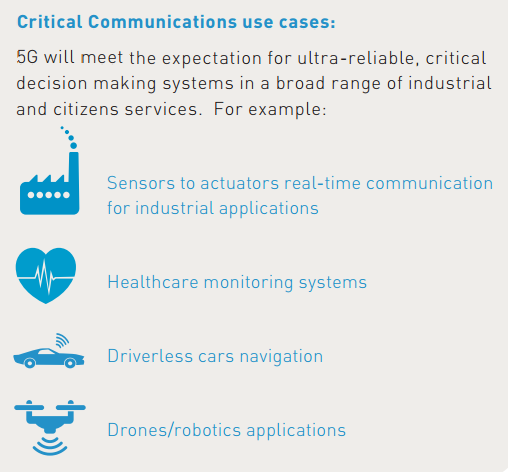
Critical Communications use cases of 5G
Read more: What is 5G communication up to?
With the advent of Jio into Indian market, 4G communication has spread widely into India. Other than mobile industry, 4G has spread its branches into many other sectors but with limited scope. And the technology is advancing with great pace. The entire communication industry is getting ready for the next generation of communication - 5G. However, the 5G communication will be rolled out by 2020. On the other hand, the tech giants like Google and Apple stepping into automotive industry for a smart automotive industry. Covering these two trending contexts, this article speaks about the influence of 5G communication on the automotive industry.
5G
A research by Qualcomm has uncovered startling statistics about 5G. In 2035, 5G will be able to generate a revenue of $12.3 trillion in the sector of goods and services. In case of jobs, 5G value chain alone can provide 22 million jobs.
5G communication illustration
Image source: ericsson.com
5G through technology PoV:
Though autonomous vehicles rely upon Artificial Intelligence, communication and connectivity is the key aspect. When the concept of autonomous vehicles become absolute reality, communication between machines/vehicles become mandatory. In this context, to serve the purpose of being autonomous, vehicles should communicate with huge data, which fails 3G or 4G supporting the communication. Hence, 5G could only come into rescue, as it is capable of providing tens of giga bytes of speed for tens of thousands of devices.
Connected devices and Internet of Things are advancing quickly. Hence, every device needs to connect/communicate with every other device. 5G is exactly devised to serve this purpose with the protocol called V2X (Vehicle to everything). This protocol covers connectivity to other vehicles with the protocol V2V, to pedestrians with the protocol V2P, to the networks with the protocol V2N and to the surrounding infrastructure with V2I protocol.
5G influence on environment:
As 5G works with V2X protocol, every device is connected to every other device, in turn, if one of these devices is connected to the internet, then, this forms a smart, connected and automotive network, which is simply, IoT for autonomous vehicles. As a result, the efficiency of the automobile can be improved along with the experience of the consumer. Also, this kind of connected autonomous vehicles avoid collisions, reduces air pollution nearly by 20%, avoid congestion and many more.
5G communication reduces air pollution
5G in terms of revenue:
As mentioned earlier, 5G communication technology is capable of generating a revenue of $12.3 trillion dollars by 2035. In terms of sales, 5G facilitates sales that generates a revenue of $1.4 trillion dollars in the sectors where automobiles can be used - transport, agriculture, mining and construction sectors.
5G in daily life:
We all might have read a fascinating statement - "The internet speed of NASA is 91Gbps". Literally, NASA might have spent billions of dollars to achieve such data rate. In comparison, with 5G, we will be connected to the internet with tens of giga bytes data rate. Practically, the numbers may differ but ultimately, data rate will be much faster with 5G.
With the increased need of communication, the current communication technologies 3G and 4G may not serve the purpose. On the other hand, when huge number of devices are connected to the internet, it very complex to provide data security to the user. Hence, 5G serves both the need of higher data rates and added data security.