Facial recognition tech is used in our day to day life to unlock smartphone or to tag friends on social media. Some airports use this to scan passengers before they board flight. Departments of motor vehicles use this tech to detect license fraud, identify theft.


Black lives matter
Image source - Google


Most common use of face recognition technology is law enforcement departments. After Williams case, many cities already banned using facial recognition technology.


Detroit police were trying to find out the guy whole stole watches from a Shinola retail store. The worth of the watches stolen are expected to be $3,800. The officers got access to the store security footage, zoomed into the grainy footage and squared out the picture of the suspect. Later, the picture of the suspect was run through the facial recognition software. The software came up with the person as Robert Julian-Borchak Williams, a 42-year-old from Farmington Hills, Mich., which is about 25 miles northwest of Detroit.


In January, Williams’ was arrested and taken into interrogation room. Police put three photos in front of him, out of which two photos were from the surveillance camera in the store and a photo from state-issued driver’s license. Williams denied saying that he is not the one from the surveillance footage but agreed that the person in the license is himself.


Williams was in remand for 30 hours and then release on a court bail until a court hearing on the case. At the hearing, court announced that the charges against Williams were dropped because of insufficient evidence. You can check the entire report here.


Michigan State Police - Investigative Lead Report
Image source - Google

Williams is the first person in the U.S. who got wrongfully arrested based on the false hit produced by facial recognition technology. 


The American Civil Liberties Union (ACLU) of Michigan filed a complaint against the Detroit Police Department asking the police stop using the software in investigations. After Williams case, the department passed a bill of new rules. Now, only still photos should be used for facial recognition not the surveillance footages. Only in the case of violent crimes, facial recognition should be used.


Many Academic and government studies have demonstrated that facial recognition systems misidentify color people more often than others. Most of the nation’s law enforcement agencies have access to face recognition tools and most of the time, people who are arrested using facial recognition are not told face recognition was used to arrest them.


Companies like Amazon, Microsoft and IBM have announced that they are not selling face recognition technologies to law enforcement agencies, however many other smaller, more specialized companies, like South Carolina based DataWorks Plus, the company which supplied the Detroit Police Department with its face-scanning software are still ready to make deals.


DataWorks Plus has supplied the technology to government agencies in Santa Barbara, California, Chicago and Philadelphia.


Williams case is a wake-up call to lawmakers to enact new rules into the law to avoid such cases in future.

BLACK LIVES MATTER

Transistors are the building blocks of any electronic device. These transistors work in two states – ON and OFF, where ON represents logical 1 and OFF represent logical 0. This is very conventional and a transistor can represent either 1 or 0 at any given point of time.
Now, let us talk about the new paradigm of computing – Qubits. For Quantum computers, the approach is little different. Based upon the nature of quantum mechanics, a Qubit can represent both 0 and 1 simultaneously, the state which scientists call superposition. Qubit is the basic building block of quantum computers.
Qubits based Silicon Quantum Microchips for Quantum Computers
The state of superposition allows a quantum computer, two calculations can be performed simultaneously. For ‘n’ qubits linked together, 2n number of calculations can be performed simultaneously.
As team of scientists from the University of New South Wales, Australia have been working on qubits for quantum computers. According to their research, theoretically, a quantum computer with 300 qubits is capable of performing as many calculations as the number of atoms in the visible universe at any given point of time.
Along with qubits, there are five approaches for the realization of quantum computers – Silicon spin qubits, Topological qubits, Ion traps, Diamond vacancies and Superconducting loops.
Though there is rigorous research being carried on quantum computing, the results are not yet up to the mark. The major challenged faced by quantum computing using qubits is its vulnerability to noise and temperature. Scientists are working on methods to reduce these vulnerabilities. On the other hand, the number of qubits that can be accumulated per chip is also challenging.
Andrew Dzurak is the director of the Australian National Fabrication Facility at the University of New South Wales, Australia. Recently, he has published a paper which puts up the work achieved by his team.

All of the components can be manufactured using a conventional silicon chip manufacturing plant using standard CMOS materials. This is the first that integrates everything on one chip. Basically, the error correction method would allow 1 million qubits to be contained on a chip that is the same size as a conventional microprocessor. - Andrew Dzurak
STMicroelectronics is a Swiss-based electronics and semiconductor manufacturing company. L20G20IS is the latest Gyroscope launched by STMicroelectronics. The L20G20IS is a miniature 2-axis gyroscope; its dimensions are 2.0mm x 2.0mm x 0.7mm.
STMicroelectronics' L20G20IS Advanced Gyroscope
With respect to the area of the chip, these miniature dimensions are going to save an area of 1.29 square millimetres. Though this area seems to be very little, in the perspective of VLSI technology, this enables the designers fill the are a with a complete new module.
Usually, the substrates to integrate camera modules in smartphones are 0.2mm or 0.3mm in thickness. The ultra-thin L20G20IS allows the designers to integrate the module into the substrate, which eliminates the “camera-bump” we see on our regular smartphones.

Zero-Rate Level (ZRL):

Usually, image stabilization in a camera is decided by the parameter Zero-Rate Level (ZRL). It is also called Offset Calibration Error (OCE) sometimes. In simple words, this is the basic unit of measurement in a gyroscope – i.e., it is defined when there is no angular velocity applied in a given gyroscope. The STMicroelectronics’ L20G20IS ensures that it lies within given specifications, which plays a major role in image stabilization.

Rate Noise Density (RND):

Rate Noise Density (RND) is another parameter that affects image stabilization with respect to noise acquired during the image capture; higher the RND, better the stabilization. With L20G20IS, the RND has also been enhanced, which is measured to 3.8mdps/√Hz, configurable phase delay down to 1° at 20Hz, and typical ZRL of ±5dps.

The L20G20IS gyroscope is 30% faster than that of L2G2IS, operating just at 1.4mA current. In terms of booting the device, it is capable of booting in less than 70ms. The L20G20IS is compatible with single- or dual-camera modules, and is available now in the 12-lead 2mm x 2mm LGA package. Pricing is from $1.69 for orders of 1000 pieces. In application, alongside smartphones, the gyroscope can be used in Drones and IoT applications.
Electronics, till date, deal only with the frequency ranges of gigahertz. Most significantly, the radiations of gigahertz range are used in communication devices – cellular phones, Wi-Fi signals etc. But five years ago, scientists have devised photodetectors capable of detecting the frequencies of visible and near-infrared ranges. With the combination of Graphene and quantum dots, the scientists were able to create flexible photodetectors. However, these photodetectors are not capable of working in the terahertz frequency range.
Graphene helps Creating Flexible Electronics in Terahertz EM radiations

Applications of Terahertz photodetectors:

Gigahertz radiations are normally blocked by certain materials. The major advantage of terahertz radiation over gigahertz radiation is that they “penetrate” through the materials, which can block the gigahertz radiation to pass through them.  With the recent researches, scientists have created the photodetectors capable of working in the terahertz range. The immediate application of these photodetectors of terahertz range can be found in medical diagnostics and intelligent vehicles.
Applications of Terahertz Graphene photodetector
Getting into details, a team of researchers at from Chalmers University, Sweden has been working on the graphene materials to create flexible photodetectors, that operate and sustain in the terahertz range and they have succeeded! This team of researchers has recently published a journal in Applied Physics Letter.
Graphene photodetector

Transistor structure:

Field Effect Transistors (FETs) are normally built either up on a p-type or n-type substrate and a complementary channel region. The journal published by the research team is about the FET built up on a plastic substrate, with a graphene material forming the channel. The team claims that this is the base of achieving the detection of 330 – 500 GHz ranges of frequencies.
Structure of Graphene Field Effect Transistor (FET)
Terahertz graphene-based FET detectors have been demonstrated on rigid substrates such as SiO2/Silicon. And flexible devices (graphene and other concepts) have been demonstrated at RF/microwave frequencies. -  Jan Stake, head of the Terahertz and Millimetre Wave Laboratory at Chalmers.
This research makes it possible to create an environment of Internet of Things via high-bandwidth 5G technologies. Apparently, this is the transition phase of electronics from gigahertz (109 Hz) range to terahertz (1012 Hz) range.
We get honey from bees; we know that. Bees are responsible for pollination of flowers; we know that, too. Over a past decade, there is an alarming falling rate of number of bees across the globe; we know this too, but we don’t care about it! If the number of bees continue to fall in the same rate, flowers cannot pollinate naturally. This ultimately results in global environmental hazards.
Unmanned Aerial Vehicles (UAVs) for Plan Bee
Eijiro Miyako from Japan came up with an idea to use drone for cross pollination. Eijiro is a chemist at Nanomaterials Research Institute of National Institute of Advanced Industrial Science and Technology in Japan.
Statistics of Honey Bee declining population in USA
These Unmanned Aerial Vehicles (UAVs) is equipped with a sticky gel and horsehair that allow it to collect the pollen grains from a flower and drop it onto another flower, allowing cross pollination. Eijiro has developed these drones from a toy drone available on Amazon and he has been successful in implementation of artificial pollination. Eijiro wants to expand the scope of these pollinating drones with the help of AI and GPS put together. However, this is an idea he is working on.

Plan Bee:

After being inspired by the documentary Vanishing of the Bees, Anna Haldewang has opted to work on this subject for her school industrial project. After this, she has worked on artificial pollination and came up with similar concept of Eijiro’s for pollination.
The Plan Bee is to create a fleet of drones that support pollination, replacing honey bees. People working on Project Plan Bee has estimated that an army of three trillion pollinating drones are required in order to replace honey bees completely.

Colony Collapse Disorder:

Dave Goulson of University of Sussex has been studying about the bees and their existence from past 25 years. He says that the major cause of declining honey bee population is that bees being poisoned.
You’ve got bees that are hungry, infected with foreign diseases and are being poisoned all at the same time. It’s not really surprising that sometimes they die. It’s the combination of stresses that’s killing them. - Goulson.
Kenneth Beyoce, a beekeeper from Central New York has stated that Varroa mite, a parasite with its origin in Asia has caused Colony collapse disorder in bees.

There are many ways technology is helping humans. This is one of the best examples to say technology-at-its-best. Hope the technology helps continue the greenery all over again. 
The Plan Bee prototype by Anna Haldewang

V2X stands for Vehicle-to-Everything. This a mode of communication in an “ecosystem” created by a vehicle and any other “connected” entity. In simple words to say, communication between an electronic gadget and your vehicle to ease the way of living.
C-V2X stands for Cellular Vehicle-to-Everything. In V2X communication, the devices may be connected to the vehicle through ethernet, Wi-Fi or any other communication technology. But in C-V2X, the ecosystem is completely based upon the connectivity of the entities within a cellular network.
C-V2X
On 31st October, the tech giants AT&T, Qualcomm, Ford and Nokia collaborated to announce their full-fledged R&D for C-V2X communication technology in San Diego. In this context, this article presents you the top ten things you should know about C-V2X for a “connected” future.
1. C-V2X is expected to be available commercially by 2020. In March 2017, Third Generation Partnership Project (3GPP) has finalized the specifications for C-V2X. On the other hand, 5th Generation Automotive Association (5GAA) has been working on defining and testing of the technology
2. C-V2X is superior in radio performance than its predecessors. Most of the predecessors of C-V2X, including V2X, use LTE for communication. But C-V2X draws its advantage being implemented with the most advanced, sophisticated and efficient 5G communication technology. Hence, the performance of C-V2X, in comparison, varies drastically.
5G Connectivity in C-V2X
3. C-V2X is forward and backward compatible. As C-V2X is still under rigorous development, forward and backward compatibility issues are also major concerns. Also, C-V2X will be the first and full-fledged application of 5G. When a vehicle is connected to every possible entity, the amount of data transferred between the vehicle and the entities is evidently high. Along with high amounts of data, the data rate should also be high enough to provide flawless communication. High throughput, high reliability, wideband carrier support and ultra-low latency are the major advantages of 5G.
4. C-V2X is cost-effective. The world today is mobile driven. As C-V2X is a driven by mobile communication networks, the cost to bring this technology into real-time is lesser than other technologies. With this advantage, deploying, managing and maintaining C-V2X is far effective.
5. C-V2X is a safe technology. 3GPP defines rigorous minimum performance specifications that ensure a predictable, uniform and guaranteed in-field experience to enable applications as critical as road safety.
Safety in C-V2X
Safety in C-V2X
6. C-V2X is designed to work on ITS spectrum for saving lives. Vehicles equipped with C-V2X technology can be communicated in two modes – Active safety mode and Infotainment mode. For active safety mode, C-V2X implements the Intelligent Transport System (ITS) spectrum to communicate with different entities of the ecosystem. For Infotainment mode, C-V2X implements the cellular spectrum.
7. C-V2X is designed for low-latency direct communication. C-V2X Direct Communications provides enhanced range and reliability without relying on cellular network assistance or coverage. It enables exchanging real-time safety messages for V2V, V2I, and V2P without requiring any kind of cellular subscription.
8. C-V2X is designed for high-speed vehicle use cases. With the implementation of C-V2X, the control over a vehicle becomes more effective and efficient. Hence, the roads can be laid supporting up to 500 Kmph ranging speeds.
C-V2X
9. C-V2X features robust synchronization even without GNSS. Global Navigation Satellite System (GNSS) is the technology used for C-V2X vehicles for navigation. 3GPP has designed protocols for C-V2X such that the transit is not interrupted even in the absence of GNSS.
10. C-V2X focuses on security. The C-V2X technology is being developed in compliance with different security standards from International Organization for Standardization (ISO), IEEE and European Telecommunication Standards Institute (ETSI).
In vision of these advances and advantages, the momentum driving C-V2X is increasing as different Tier-1 automobile companies, mobile companies and semiconductor companies are joining hands to provide a “connected” environment for transportation.
Cognitive Neuroscience:
Cognitive Neuroscience is the study of prefrontal cortex, from where the perception of things is initiated. Neuroscientists from Princeton University collaborated with Intel to map the human mind in real time. The goal of this work is to study the working of human brain in real time – thinking, feeling, and reacting to stimuli. All these brain activities are tracked using functional Magnetic Resonance Imaging (fMRI).
Brain Mapping with AI
Decoding the brain’s activity data:
More than collecting data about the brain’s activity, analysing the data and deducing a conclusion is more complex. Researchers at the university, in collaboration with Intel Labs have developed a software that helps the neuroscientists to map the collected data from the fMRI in real time.
The research that we’re doing uses fMRI human brain imaging to view what’s going on inside the brain as people think and feel. - Jonathan Cohen, a neuroscience professor and co-director of the Princeton Neuroscience Institute.
The data from fMRI is mentioned in terms of ‘voxel’. Technically, a voxel is a three-dimensional pixel. It can be assumed as a pixel-sized cube. With the help of the software, the neuroscientists were able to deduce thoughts and emotions from neural activity and the amount of blood flow, based on the sensory stimuli.
The neuroscientists have concluded that the mental conditions like depressions, disorders, anxiety and schizophrenia are caused due to disorders in prefrontal cortex. The neuroscientists opine that the study of cortex can provide definite solutions to all the brain-related problems.
We hope to apply what we learn from these studies of human cognition to machine learning and artificial intelligence. This may lead to safer autonomous driving, quicker drug discovery and earlier detection of cancer. - Ted Willke, senior principal engineer at Intel Labs.
Open-source:
As a part of this research, the neuroscientists have provided the tool Brain Imaging Analysis Kit (BrainIAK), that helps other neuroscientists to work with their fMRI scans.
Intel has a team named Mind’s Eye, that works on converting the data and patterns availed from cognitive neuroscience to apply them in Machine Learning and Artificial Intelligence.
Cognitive Neuroscience
Virtual Screening:

Virtual Screening is a new technique that figures out the set of molecules those are most likely to absorb a given drug and act immediately for curing the disorder. Scientists suggest that the data collected from fMRI scans can be used to analyse such “active” parts of the human brain, which is a revolutionary step of technology towards better health.
Image source: Intel
It’s already the second week of November and you should’ve probably listened to the Taryn Southern’s “Break Free” from I AM AI. And YES! The music was composed by Amper, the music machine that composes using its very “Artificial Intelligence.” “Break Free” is the first single from this album and the complete album will be released into the market soon. Taryn has written the lyrics and sang it; the rest was done by Amper.
Taryn Southern from Break Free
And the amazing fact about Amper is that it is an open-source system! The more amazing fact is that the complete music was created with Apple MacBook Pro including managing the music, and digital and 360-degree video editing! **SCREAM NOW!!**
It started out as a creative challenge. Every tool has its own constraints, but it became clear I could use this technology to create something really awesome. All of the actual composition — the chords and rhythms — that’s all Amper. Where I lend the greatest force is in creating song structure, and pulling in and out certain instruments to build a song the way my ear wants to hear it. - Taryn Southern.
Just like any other AI machine, Amper has also learned composing music by analysing the existing music. As an artificially intelligent machine, Amper has parsed and learned different patterns of the music – rhythms, chords, tempos, beats, genres, moods, other musical building blocks and their correlations. Amper has composed the music from its understanding of the existing music and its patterns.
However, it is not as simple as a machine learning music. Taryn has stated that she was able to create the music by tweaking the composition in several rounds – input the parameters of music – listen – tweak – input again – iterate. The input parameters include tempo, orchestration, beat, mood, style and other factors of music.
Taryn has been working on composing music from AI and related tools from a few years. Before settling to compose music in collaboration with Amper, she explored different AI products like Flow Machines from Sony. Also, Taryn has addressed the gathering at The Next Web (TNW) conference, explaining how technology can create, recreate or even enhance content.
Taryn Southern at TNW Conference
Exactly to mention, Sony has first ventured into composing music from AI with its Flow Machines. On the other hand, Google is also into the field by extending its support to the open source project Magenta. 
Check out the AI Music "Break Free"!
The Automobile industry is looking towards the Autonomous Cars. Within a few years, the “human-driven” cars will be completely replaced by Autonomous cars. Experts from BMW, Carnegie Mellon University and Intel opine that the autonomous cars are going to change the interior of a car.
Autonomous Cars Interior
There are many advantages that enhance the transit of the passenger, where being driverless is the most significant one. Controlling the car during the transit is major aspect the resources become redundant. With autonomous cars, this redundancy can be eliminated, which can relax the need of a driver. This ultimately results in a car revolution, which reshapes the interior of the car look like living room, offices or even sleeping pods.
Hans-Joachim Faulstroh, the Head of Interior, HMI and UX at BMW, Munich compared the autonomous cars to emotional possessions.
We love our cars because they are emotional possessions. We have a deep relationship with them. We take care of them and they take care of us.
At the Consumer Electronics Show (CES) 2017, BMW has showcased its prototypes – BMW i Inside Future – with the possible User Experience with Autonomous Cars. Here is a glance at these sculptures.
BMW i Inside Future Sculptures
The BMW i Inside Future represents the future with the car controls like temperature, music, speed control, HUD, routing, mobile docking etc. can be handled via BMW HoloActive Touch. The MBW HoloActive Touch is a hologram display that enables the user to interact with the holograms its “floating images”.
Dr. Stan Cladwell, Associate Professor at Carnegie Mellon University has devoted his life for developing smart transportation systems. He said that the first autonomous car was conceptualized in 1939 itself, by General Motors (GM). He says that the first public autonomous car will be available by 2020!
It was at the 1939 World’s Fair that General Motors announced its vision for the first autonomous vehicle. It wasn’t very long after that we began thinking, ‘Wouldn’t it be great if we didn’t have to actually operate them? I think we’ll look back one day and say, ‘When did we stop driving?’ and not really know. It’s going to happen gradually as the technology becomes less expensive and more publicly accepted.
Indeed, similar is the evolution of communication from letters to smartphones, which has devastated many conventional needs of computers, communication devices, audio players, video players and many other devices. Today, the world grew and is growing so that it cannot be held without a mobile device intact!
Autonomous Car Simulation
Consumer Technology Association, a survey association, has conducted two different surveys. The first survey is about the pro-autonomous cars and the other is about the contrasting aspect. The first survey has revealed that 70% of the participants are interested in testing a driverless car and 62% of the participants are ready to replace their conventional cars with the autonomous ones. The second survey has revealed that 78% of the participants are afraid of the autonomous cars due to various reasons.
Partners of Autonomous Car development
Technically speaking, be it good or bad, the degree is very high. The advantages – being driverless, minimal interaction with the vehicle during transit, time optimization, utilization of fuel efficiently, route mapping – are not being completely balancing the security aspect of these autonomous cars. However, autonomous cars can be noted as a remarkable advancement in the automobile industry.
Always, we are surrounded by some radiation or the other – mobile signals, Wi-Fi signal, FM signals etc. In a metro city, we are a lot surrounded by these signals. Just imagine that we can visualize these signals/radiations around us. Luis Hernan from Newcastle University has designed a device that visualizes these signals. Ironically, the device enables us to visualize only the Wi-Fi signals.
Wi-Fi Visualization by Digital Ethereal
Kirlian Device is the device that was developed by Luis that turns the internet signals into vibrant LED-based visualizations. Luis is a PhD candidate with the Architecture and Interaction Design Group. Previously, a blogger Nickolay Lamm, has imagined the geometry of the Wi-Fi signals, as if they belong to the visible spectrum of electromagnetic radiation. Here are the images by Nickolay from his imagination.
 
Nickolay Lamm Imagination of Wi-Fi Signals at different locations
Unlike Nick’s imagination, the Kirlian Device is capable of turning real data into visuals. Digging little more, the Kirlian Device was developed by Digital Ethereal, the company owned by Hernan. Kirlian gadget translates the Wi-Fi signals that it captures with and LED panel, based upon the signal strength. The gadget displays red colour for high intensity signals and blue for low intensity signals.
Due to the brightness of the device, my figure is ghosted away in the process. In some pictures you can see my feet or even my blurred head underneath the light strikes. I believe our interaction with this landscape of electromagnetic signals…can be characterized in the same terms as that with ghosts and spectra. They both are paradoxical entities; whose untypical substance allows them to be an invisible presence. In the same way, they undergo a process of gradual substantiation to become temporarily available to perception. Finally, they both haunt us. – Hernan, in an interview with Discovery.
Hernan compares his work of Wi-Fi signal visualization with the visualization of ghosts. Hernan’s accomplishment is based upon the work from Arnall, Knutsen and Martinussen from the Touch Research project. They have introduced long-exposure and Received Strength Signal Indicator (RSSI) sensors to visualize and spatialize Wi-Fi networks Lightpainting WiFi.
Wi-Fi visualizations by Kirlian Device
On the other hand, Hernan has also developed a mobile app – Kirlian Device mobile app that indicates the Wi-Fi signal strength in the app. It indicates the strength of the signal just by displaying relevant colour upon the screen; red being high intensity signal and blue being low intensity signal. 
Image courtesy: Digital Ethereal
Microsoft has been working on different divergent technologies. Mixed Reality, Virtual Reality and Augmented reality are the latest major works of Microsoft. Recently, a patent application from Microsoft has been found. You can follow the patent here.
Microsoft patented Augmented Reality Wand aside its Mixed Reality
According to this patent application, Microsoft is developing an augmented reality input device. This seems very much like a motion controller for the Augmented Reality environment. This band comes with buttons, a trigger and a finger guard. The appearance of this wand is very similar to that of Google's Draw for Google Glass. 
According to sources, Microsoft has applied for this patent in June, 2016 and evidently the company has released its Mixed Reality vision video. Based upon the video released, the Augmented Reality wand can be used with HTC Vive VR Headset. This gives us a hint that Microsoft is working effectively in the world of Virtual/Augmented/Mixed reality. 
Perspective view of an Augmented Reality input design
Fig 1:Perspective view of an Augmented Reality input design
Later this year, Microsoft is planning to release its Mixed Reality headsets in collaboration with Acer, HP, Lenovo, Dell and Asus. These headsets are expected to be starting at a price of $299 USD. Microsoft is focusing on six degrees of freedom tracking without the need for traditional external sensors placed throughout a room. The minimum specs for Microsoft’s Mixed Reality platform also indicate most PCs will be capable of running the most basic apps and games.
The automotive industry is "driving" towards autonomous cars. The concept of autonomous cars are helpful in several ways - enhances road safety, provides navigation, reduces the losses caused by wear and tear, provides transport for every individual and the list goes on. But, what does an autonomous car run upon, other than mechanics? The very next answer is a combination of Electronic Control Units (ECUs) and millions of LoC (Lines of Code). So, what is the degree of security that autonomous cars provide?
Autonomous car and their security concerns for better future
Long back in 2014, when the concept of autonomous car was emerging, two American hackers Charlie Miller and Chris Valasek threw a challenge upon the security of autonomous cars. These 'security researchers' were able to take control over an autonomous car. They didn't use rocket science and complex equations to achieve this; but just with a laptop, they were able to override the control system of the car. The good thing is their test was successful and the better is that they just 'tested' the security of the car. 
The context was long back, when Internet of Things (IoT) has not come into picture. For time being, let us objectify IoT as just a module added to autonomous car for omnipotent data access and control. The module of IoT is another set of millions of LoC. According to the principle of coding, the more the LoC, the more the application is vulnerable. Today, every autonomous car is targeting to integrate the IoT connectivity to develop the concepts like connected cars and Vehicle to everything (V2X) connectivity. Under such conditions, the LoC increases enormously, which finally imparts unexpected vulnerabilities.
In the recent panel NXP FTF Connects Silicon Valley, Hadi Nahari, Security professional and CEO of Cognomotiv has expressed his view about the security in autonomous cars. Another member of the panel Lars Reger, CTO of NXP's Automotive and Jeff Stewart from Auto-ISAC have opined about the security with respect to the sophisticated emerging technologies.
Panel at the NXP FTF Connects Silicon Valley
Bundles of code turn vehicles into software platforms, and the autonomous industry is figuring out how to deal with it. - Hadi Nahari
The more things are connected, the better they need to be protected. A car could be compared to a house. It has several doors and locks, located at various places inside the house. Locks in the autonomous industry consist of hardware and software solutions located at various places in the vehicle network to protect each component (e.g. ECU) from malware and unauthorized access. - Lars Reger
Due to the raising sophistication of technology, the issue of security is becoming ever more complex and more difficult. - Jeff Stewart

Verdict of security in Autonomous cars:

For any system, both the hardware and software plays equal role in the operation of the system; autonomous car is not an exception. So, not just the software or hardware but it is also about the information about the vulnerabilities in different systems of the industry.
The verdict of the panel about the security for autonomous cars is that proper design and proper techniques that are thoroughly tested could help achieving better security levels. Also, the automotive industry needs more information security researchers for providing tough autonomous cars and connected bodies.
Artificial Photosynthesis is going to start a new era in human history. Scientists at University of California Berkeley are working on creating the phenomenon of photosynthesis artificially. As of now, the research team has created a bioreactor consisting of bacteria loaded with Cadmium Sulphide semiconductor nanocrystals. This setup converts the light, water and sunlight into useful chemicals, which are expected to be the chemicals that appear during photosynthesis.
Artificial Photosynthesis through semiconductor nanocrystals

Kelsey K Sakimoto of Peidong Yang, Berkely has been working on cyborg bacteria. In the National Meeting and Exposition of the American Chemical Society, he has demonstrated the bacterial called Moorella Thermoacetica, that is capable of self-assembling into nanocrystals cyborgs. These cyborgs can super charge the bacteria present in the reactor into CO2-reduction powerhouses.
It's actually a natural, overlooked feature of their biology. This bacterium has a detoxification pathway, meaning if it encounters a toxic metal, like cadmium, it will try to precipitate it out, thereby detoxifying it. So when we introduce cadmium ions into the growth medium in which M. thermoacetica is hanging out, it will convert the amino acid cysteine into sulfide, which precipitates out cadmium as cadmium sulfide. The crystals then assemble and stick onto the bacterium through normal electrostatic interactions. - Sakimoto.

Principle of semiconductors for CO2 reduction:

Semiconductor materials have a bandgap, and when photons with energy levels greater than that of the bandgap, electron-hole pairs are generated. Once can assume bandgap as the threshold energy of a material either to act as a conductor or an insulator. This is the principle through which semiconductor materials are used for converting solar energy into electrical energy. This principle is the base of reducing CO2 reduction through artificial photosynthesis.

Functioning of the reactor:

The enzymes in the bacteria's membrane associate and attach themselves to the nanocrystal. When the cadmium sulfide is excited with light, the excited electron from the conduction band is injected into the enzyme, which produces some sort of biological electron carrier (like H2) that is used for the CO2 fixation pathway. The position of the conduction band is crucial as it must be high enough to pass into the enzyme, which is expected to be hydrogenase.
The nanocrystal-clad bacteria are able to achieve a high breakdown efficiency of up to 84 percent, overcoming the issue of a CO2 reduction in which a soup of byproducts results from the process. While this approach doesn’t lead to a synthetic fuel, like ethanol, it does produce just one product: acetic acid.
While acetic acid isn't terribly useful on its own, other bacteria love it. We have strains of engineered E. coli that are engineered to eat the acetic acid and produce butanol, the bioplastic polyhydroxybutyrate, and a family of pharmaceutical compounds. We think acetic acid is an ideal intermediate product as most engineered strains of bacteria can use it to really make any product under the sun.
Advanced Driver Assistance Systems (ADAS) were introduced to provide assistance to the drivers. The ADASs use different devices like radars, ultrasonic sensors and cameras for the purposes like lane keeping, collision warning etc. The raw data from all of these devices is collected and processed before it is transmitted to the ADAS.
Mentor Graphics' automated driving with Level 5 Self-driving platform
DRS360 is the Mentor Graphics' platform for ADAS. It is powered by Xilinx Zynq UltraScale+ MPSoC FPGAs. It supports machine learning through advanced algorithms for neural networking. The DRS360 platform uses the "raw data" paradigm, which reduces the complexity of OEMs. The DR360 platform supports most of the leading sensors available in the market alongside the x86-based boards and ARM boards that support autonomous driving.
Read more: Cellular Vehicle to Everything technology.

Features of DRS360:


  • It provides access to data at different levels based upon the demand - Raw, fused and perception data.
  • High performance at reasonably lower power consumption. 
  • The raw data from the sensors on the automobile can be fused at multiple levels, which reduces the latency.
  • Through the raw data collected, the machine learning capabilities for processing the data can be enhanced.
  • Automotive-grade platform: designed and tested for deployment in ISO 26262 ASIL D-compliant systems.

Fuse raw data from multiple sensors in real time:

From full sensor processing and control to delivering Level 5 functions through a single protected interface, DRS360 is a groundbreaking autonomous driving solution for auto OEMs and autonomous drive (AD) developers. An architecture built around centralized FPGA-based processing and machine learning reduces computation and integration complexity while boosting power efficiency. The result is an AD system delivering the most complete and accurate view of a vehicle’s surroundings in all driving conditions.
DRS360 direct raw sensing

Centralized raw data fusion vs. Classical data processing:

In recent years, the drive to implement ever more ADAS features has led to a proliferation of sensors around the vehicle. Traditionally these ADAS systems have used a distributed compute architecture that pushes data processing to each node. That is, the camera, RADAR, LIDAR and other sensors wind up independently filtering and processing streams of data, which are then sent to different applications or fusion modules.
Classical Data Processing
The distributed approach is beset by a host of problems, including unacceptable system latency in the transfer of safety critical information, the loss of potentially useful data at the edge nodes, and rapid increases in cost and power consumption as driver-assist systems become more complicated.
Is it even possible to efficiently scale up from this architecture to reach Level 5 autonomy? We doubt it, and that’s why we developed the DRS360 platform.
DRS360 Centrailzed Data Fusion

Drawbacks to the classical approach to ADAS/AD: 

excessive power consumption and software complexity.
DRS360 takes a different approach: centralized raw data fusion. Rather than try to scale lower levels of ADAS up, DRS360 is a system optimized for Level 5 autonomous drive, and engineered to easily scale down to Levels 4, 3 and even 2.
Read more: Microsoft's Connected vehicle platform.
Centralized raw data fusion eliminates the inherent limitation of today’s distributed ADAS/AD architectures. DRS360 connects raw sensor data to a centralized automated driving compute module over high-speed communication lines, and then fuses this data in real time. A high-speed, low latency communication framework developed by Mentor makes all sensor data — raw and processed — available across the system at all times. With access to a high-resolution model of the vehicle’s surrounding environment, our perception algorithms make decisions faster and with more processing efficiency than other ADAS/AD solutions. And our use of advanced neural networking caps DRS360 power consumption at just 100 watts.
The DRS360 platform and its innovative, centralized raw data fusion approach is the only automotive-grade, production-intent solution for Level 5 autonomous driving currently available on the market.
Finally the day has come! And it's Android Oreo, officially. Google has packed many exciting features with Android O. Let's check out what these features are.
Android Oreo

2x Faster:

Get your device ready two times faster - The boot time has been reduced to half* of the previous Android versions.
*Measured on Google Pixel.
Read more: Android O Update for Nexus and Pixel devices

Minimized background activity:

Google has enabled Oreo to minimize the background activity, which can be felt upon on-hand performance.

Autofill:

Just like you use autofill in Google Chrome, Oreo comes with the feature of autofill. This helps you reach out your favourite app just with a sequence of touches. Anyway, it will be done only with the user permission.
Autofill with Android Oreo

Picture-in-Picture:

On Youtube, you will be able to continue watching the video till you find another video to stream. On Skype, you will be able to see both your video stream and the caller's video stream. This feature is going to be available with Oreo.
Picture-in-Picture Android Oreo

Notification dots:

With the new notification dots can have a quick glance at the notifications from the list of apps. And clearing them is as usual - Swipe.
Notification Dots and Instant Apps of Android Oreo

Android instant apps:

Till now, you're getting related app results on Google Chrome or Google Now from your device. When you open such results, you will be redirected to the app. If the app is not installed, you cannot access such content. With Oreo, the UX is going to be more impressive - you need not install the app; you can directly port into the app.

Enhanced Google Play Protect security:

With Oreo, Google Play Protect app can provide better security, at a frequency of scanning 50 billion apps every day.

Better battery life:

Battery life is a prominent update from Kitkat to Lollipop and this iteration of Android the battery life is still improved.
Read more: Android Life cycle - How you get Android OTA updates?

Emojis:

A new set of more than 60 Emojis with more expression are added to Oreo.
Emojis of Android Oreo
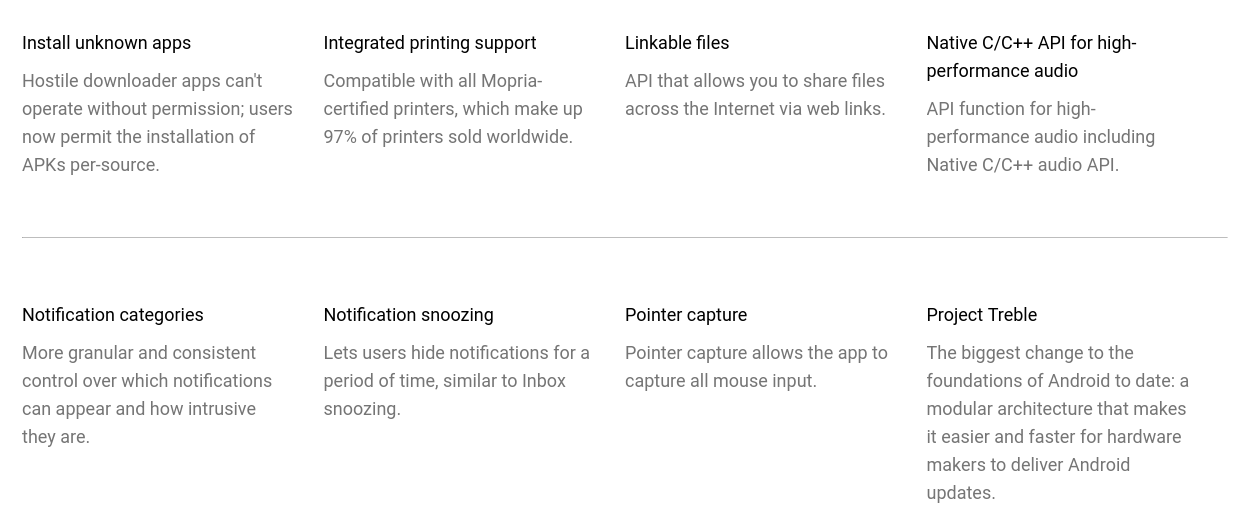
Here is are two snippets listing out still more new features of Android Oreo.
Features of Android Oreo Snippet-1
Features of Android Oreo Snippet-2